Saint Patrick’s Chapel was built in 1899 as an attachment to the Saint Jerome Church. As mentioned at the last stop (4), the Notre Dame Convent has a chapel attached to its back named the Saint Joseph’s Chapel for Nuns. There once was an alleyway through the Saint Jerome block but the church chapel blocked that. There is a third chapel in the back of the church proper.
The first school on the campus was the Notre Dame School. The teachers were the Notre Dame nuns and a convent was built for them that year of 1869 when the school opened. The convent remains the oldest structure on the Holyoke campus of St Jerome’s.
The school was a wooden home that was moved from Elm Street to Hampden Street. This was the second girls’ school in the old Springfield Diocese (Worcester, Hampden, Hampshire, Franklin, and Berkshire). The first girls’ school was at Holy Name of Jesus in Chicopee. A nun’s chapel was added in 1872 to the back of the convent. This wooden structure was replaced in 1883 with the brick school Immaculate Conception of the Notre Dame of Lourdes. The wooden school was moved to Worcester Place and lasted until 1980.
Jeremiah O’Callaghan was the first priest and when he died the next year he was buried alongside the east wall of the young church. He was the first priest buried alongside his church in Holyoke. Father Michael Howard was buried alongside Rosary Church and Father Andre Dufresne was buried alongside the Precious Blood Church. Father Sullivan served for 5 years and started Saint Jerome Cemetery. Then came the Builder – Father Patrick Joseph Harkins. He started many institutions and had built many structures.
Saint Jerome Church was rebuilt in 1885 since the Irish population of Holyoke had expanded greatly. The front half was retained but the back half was widen and lengthened. This church was burnt in 1934 and rebuilt the next year. The plan was the same but new materials were used except for the bell. The only visible change was the removal of the clock faces in the steeple.
Saint Jerome Church started in 1856 as a parish. A parish is the congregation that meets together for worship. Some of the early masses were celebrated at the Exchange Hall and some outdoors. Before 1856 the Catholics went to St Matthews Church in Chicopee. At times the priest came to Holyoke and mass would be held in private homes, outdoors, and at the Dam House. The first church was finished and dedicated in 1860.
Click on the link above to read about this stop. (LOCATION) The South Hadley Canal is the first canal for navigation on the continent. The only competitor to this claim is the Carondelet Canal. This canal was made in 1794 from Lake Pontchartrain in Louisiana to the Bayou Street Juncture in New Orleans. A two mile canal was dug at first at 15 feet wide. There was no locks on the system. The canal might have been used first in December of that year. The South Hadley Canal might have also been used in December of that year. The Carondelet was not in the territory of the United States yet. Thus the South Hadley Canal beats the Carondelet Canal in two aspects that of being within the United States has it was defined in 1794 and also in that it had a lifting mechanism.
The South Hadley Canal is one of six navigation canals along the Connecticut River. Read about this incredible system at the LINK.
The Carew Paper Mill was here from June 19 1848. The old navigation canal was redone so that it was both at the same time a navigation canal and a power canal. In 1873 their mill burned but it was rebuilt. The Carew lasted as a company until 1948. Texon took it over and they kept the building open until 1986.
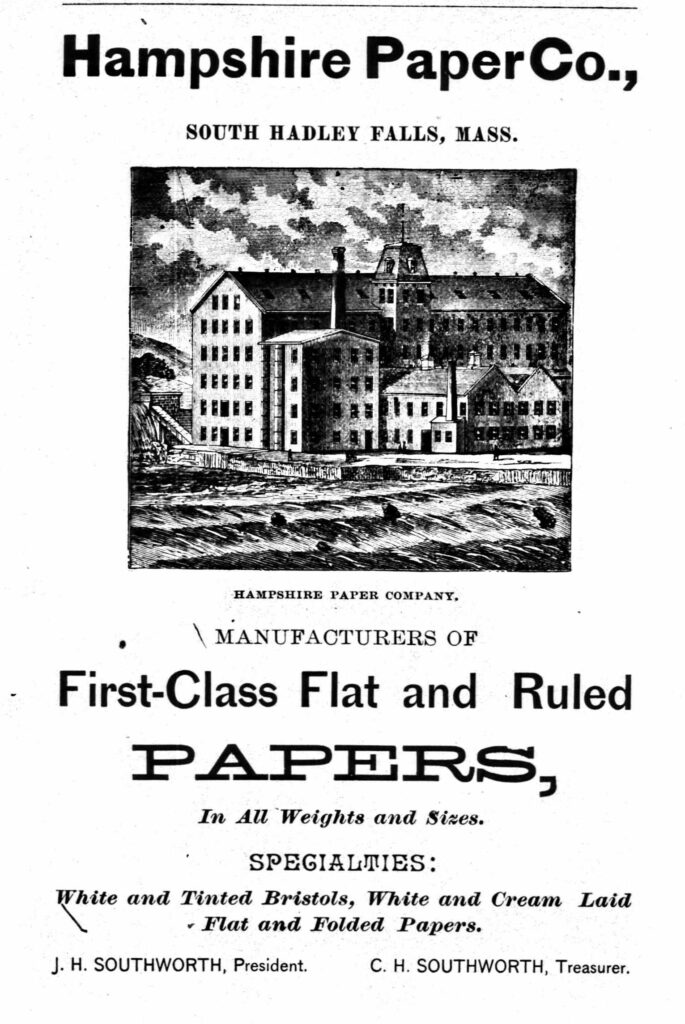
Between Texon Park and Lower Riverside Park there was the Hampshire Paper Mill. This was built alongside the Carew in 1864. It lasted until 1935 when it finally closed. The Stevens Paper Mill moved into this mill in 1940 and kept it until 1968 when it razed the building two years later. A plan of the Stevens is HERE.
The original Catholic orphanages were in the downtown Holyoke area. When the Sisters of Charity nuns arrived in 1873 from Ontario they were teachers and ran a tiny orphanage. The first one was in the Providence Hospital in South Hadley that had been used as a hospital for one year and then as an orphanage for a year. The orphanage was then moved to a house in Holyoke for about a year. Then it was moved into the top floor of the Providence Hospital for a year. Then into the second floor of the Saint Jerome Institute (on Hampden Street) for a few years. Finally, in 1880, into the Ingleside area at the Mount Saint Vincent Asylum.
Brightside was the name of a farm along the West Springfield and Holyoke border. That name Brightside was the name taken on by the orphanage for boys. Its formal name was Holy Family Institute at Brightside. Most people then and now call it Brightside. Brightside was owned by Warren Wilkinson. When he died in 1892 the bishop purchased the property and land (123 acres in all) in order to build an orphanage.
The boys orphanage stayed at this location until 1954 when they moved a quarter mile to the south into a newly built Brightside homes. From 1954 to 1991 it was called the Sisters of Providence Children’s Home and was for both boys and girls. Then the name was changed back in 1991 and then Brightside closed in 2009. Adjacent to Brightside housing was their school and administration. This is now the new Hillside Residence is a 34-unit affordable elderly housing facility and also the refurbished de Paul Center which was the school. The entire campus is called the Hillside at Providence.
Between the motherhouse and Brightside is a new place called Mary’s Meadow (IMAGE) and it opened in 2005. It is a 40-bed, small house concept skilled nursing and rehabilitation facility.
The Sisters of Providence of St Vincent de Paul served in many locations around the Connecticut River Valley. When they served an institution they would have a convent nearby to house themselves. This was a decent arrangement but having a motherhouse was better. In 1932 they finally had a motherhouse built for themselves. It is located down Gamelin Road in the Brightside neighborhood. Near the corner of their Brightside motherhouse there was erected a statuefor Catherine Horan who was the first mother superior for the Holyoke order.
You met her back at the Calvary Cemetery for the Sisters of Providence. Great woman with a fitting memorial for her. Their motherhouse is now called Providence Place at Ingleside.
The base of the statue reads:
“… from the hilltop I view the progress the tiny seed has made under the protection of Divine Providence.”
The Sisters of Providence Chapel is very beautiful. It is named the Mother of Sorrows Chapel. The CHAPEL can be seen in all its glory at this LINK. It was finished in 1933. The chapel has a Skinner Organ.
The Sisters of Providence nuns also ran the Mercy Hospital in Springfield, the Farren Memorial Hospital in Montague, the St. Vincent Hospital in Worcester, and St. Luke’s Hospital in Pittsfield.
In 2001 the Rutland Vermont congregation joined with the Springfield congregation of the Sisters of Saint Joseph. This was likewise a union that preserved the nuns in their location but joined the administrations. This Rutland order had started September 6 1873. They opened a convent in 1882.
The Sisters of Saint Joseph have a long history in Holyoke. They are an international order of nuns. In Western Massachusetts they started out in Springfield in 1883. Their motherhouse was in Springfield from the 1880s to the 1960s. Mont Marie was their summer house. It was started here in 1894 as a connected set of buildings similar to the layout now seen. It also functioned as a novitiate for their novice nuns. In 1953, a new Mont Marie structure was built here and this location became a permanent home.
Before 1894 there was another structure at this location. It was called Ingleside. It was a resort but only lasted from July 4 1868 to July 26 1875. The structure burned on the latter date. The hotel was located outside the fire limits of the city and so there was no water to draw upon. Only the furniture could be saved.
In 1974, the Fall River Massachusetts congregation joined with the Springfield congregation of the Sisters of Saint Joseph. This was a union that preserved the nuns in their location but joined the administrations. This order was founded in 1902 at the St Roch Church.
Dwight Manufacturing Company Housing on Sandy Hill
Parallel streets are Lyman, Lawrence, Gardner, and Coolidge Roads. Perpendicular street is Nichols Road. The houses on Lawrence, Gardner, and Coolidge are from 1907 to 1908. The houses on Lyman are from 1921 to 1927. Take Lawrence Road from Chicopee Street to get to this worker home area. On the eastern side of Nichols Road are back to back housing of the same era (post-1927). Dwight Terrace leads to Chicopee Street via a series of wooden steps. There is an abandoned fire station at Lawrence and Nichols.
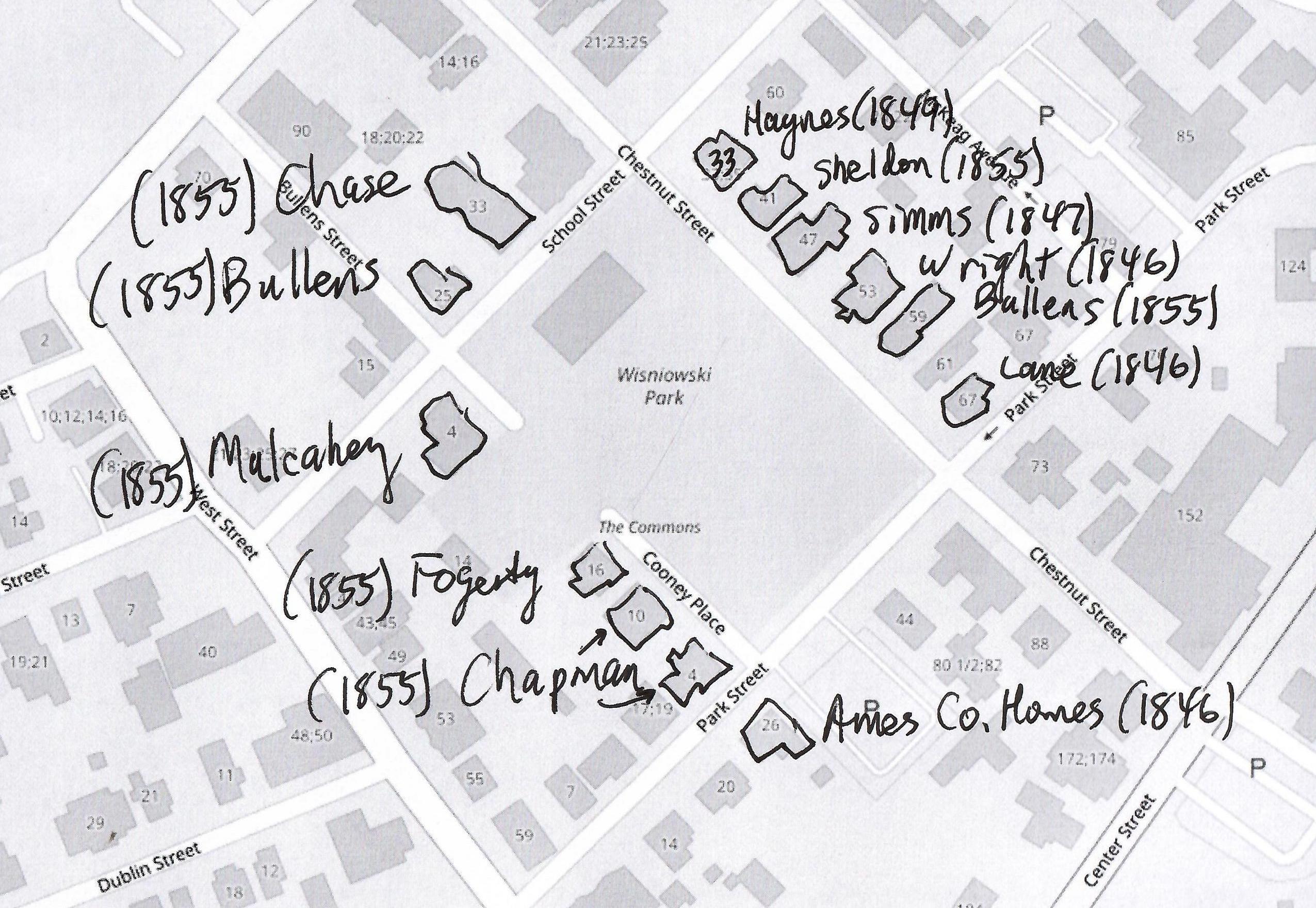
The original settlement in this area was centered around the Cabotville neighborhood. (LOCATION) It includes a park and many homes and once included a school. The streets that form the area are West, Park, School, and Chestnut Streets. Most of the homes that you see are from the 1850s to the 1870s.