
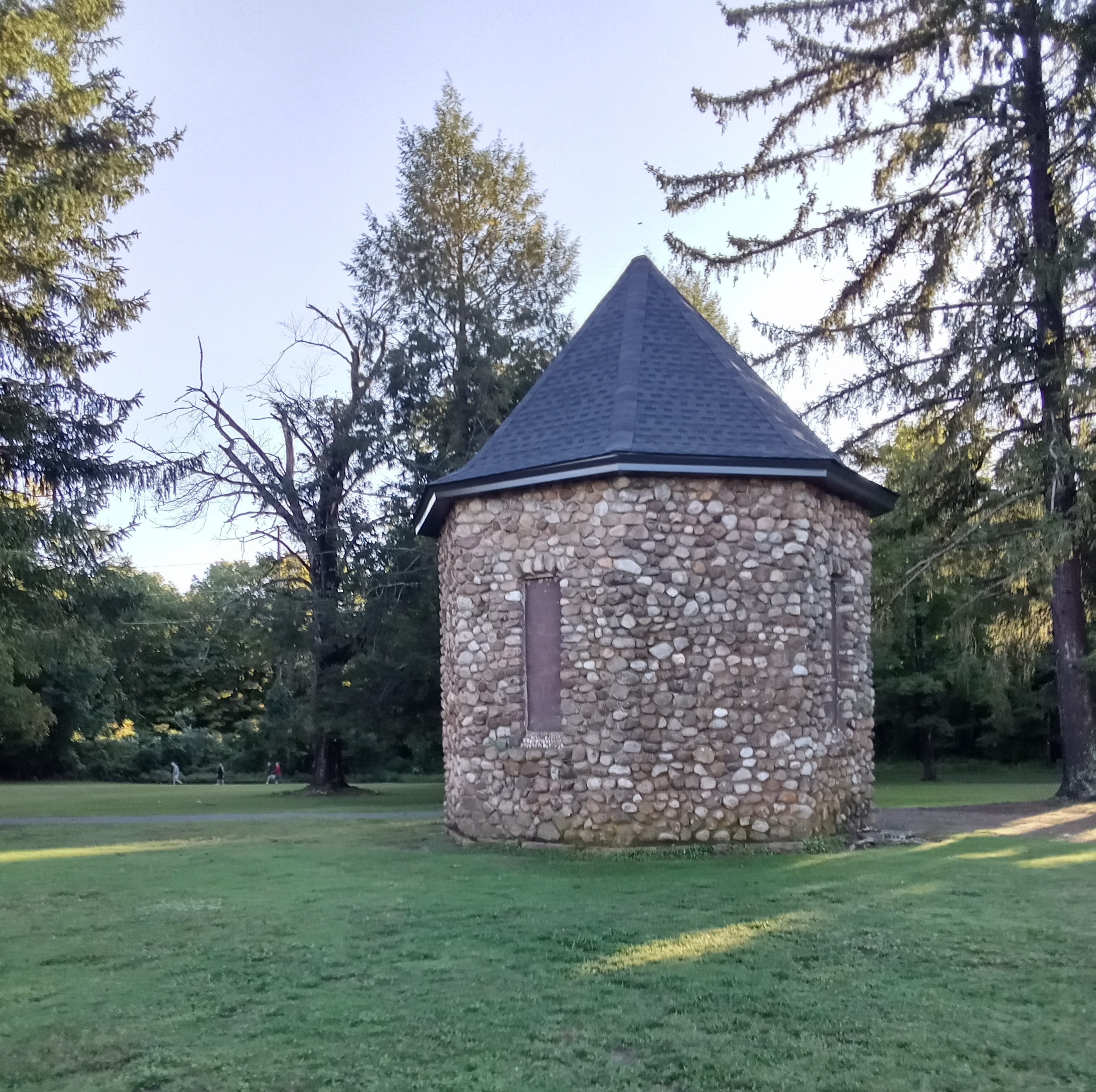
Ashley Gatehouse
The Ashley Dam (LOCATION) was started in 1875. The composition of the dam is that cement was first put in the base, masonry and concrete is added atop that, and then 2 feet of gravel. As you can see a grass crown and berm is the finishing material. The dam is mostly underground. It is 12 feet high and 640 feet long. In 1883 the dam was raised even more.
If the drinking water of the Ashley Reservoir System flows out at the rock cut canal at the east edge of Wright’s Pond, then why is a gatehouse back here even needed? From 1897 to 1898, the Fomer Reservoir in Southampton was joined via an 10.5 mile long pipeline to this southern point of Ashley Reservoir. This Fomer Pipeline would cost a quarter million dollars. This pipeline passes through East Mountain at the Bush Notch. The average depth of the pipeline is 5 feet and the greatest depth was 18 feet. It enters at the gatehouse here. There is a canal below your feet that helps the water enter Ashley. The dimensions of this terminal canal is 15 feet wide, 43 feet long, and 7 feet deep under the surface. The walls that contain it are 2 feet think and made of stone. That means the height of the canal is 5 feet. In that canal is a weir that slows down the water. The reason that a slow down of the piped water is needed is that the difference in height from the Fomer Intake to the Ashley weir is 114 feet. At such a great pressure the water would shot out into the basin and cause great turbidity. The overall effect is that 4 million gallons per day is added to the Ashley Reservoir (and 1 million gallons per day is added to McLean).
In 1903, three new pipelines were put in:
- a pipe south of Ashley to the gatehouse at Wright
- a double connection pipe with High Service Reservoir (Bray)
- a single connection pipe with Bray (gated so only one pipe could function at a given time)
In 1921 to 1928 another pipeline was added that parallels this one. Still later a third one was added that runs up to McLean from here. The second pipeline was placed into the same rock channel that held the first pipeline. This is since the first dig was 6 feet wide and by intent allowed for another pipeline by the side of the first. This second pipeline was built a few years after the White Reservoir was finished in Westhampton in 1913. This second pipeline adds 4.65 million gallons per day to the reservoir. The cost of the second pipe is $403,321.
These pipelines from Southampton to Holyoke have been changed in configuration a few times. In 1951 the pipelines as it passed by Barnes Air Field had to be lowered by 2 feet. In 1955, when the Massachusetts Turnpike was put in, the pipelines had to be brought to the north a bit. These pipelines also have special features added to them. Blow-offs are added at low points to get rid of pockets of air. Air valves are at the high points to blow off air.