Comeau and Spoor – 5th Generation Data 1 – Edwin Spoor – 1830 birth might never have been recorded since Vermont did not require it – might have to obtain baptism record from United Methodist Church in Saint Albans area – might have been born in Franklin, Georgia, Saint Albans Town, or Saint Albans City – parents are Orange Spoor and Mathilde Morris
2 – Jean-Baptiste Gauthier dit Marcoux – place for 3 March 1841 Quebec birth to Charles Gauthier and Lucie Potvin – his parents were married in Saint-Césaire, Rouville, Quebec in 1835
Comeau and Spoor – Births in 6th Generation 1 – Patrick Henley – 1786 birth in Perce Quebec to James Henley and Catherine Chicoine – probably never was recorded since baptism was years later due to lack of a priest in area
2 – Louis Mignier dit Lagacé – 1800 birth in St Hilaire Quebec to Jean Minier dit Lagace and Genevieve Menard
4 – Etienne Fournier – 1816 birth in Matane Quebec to Etienne Fournier and Victoire Langlois
Comeau and Spoor – Deaths in 6th generations
1 – Adélaïde L’Écuyer – death date and place
2 – Marie Pélagie Benoit dit Livernois – death date and place
3 – Julian Brault – death date and place
4 – Domitilde Julie Piquet – death date and place – before 1890 – wife of Julian Brault who she married in 1833 in Saint-Jacques-de-l’Achigan of Quebec – she last appears on a document in 1871 in Saint-Alexandre, Iberville of Quebec
5 – Mathilde Morris – death date and place – difficult situation
6 – Jean-Baptiste Gagnon – death date and place – perhaps in 1870s
Comeau and Spoor – Marriages in 6th generation
Orange Spoor and Mathilde Morris – marriage date and place are unknown – her parents are unknown but his parents are Abraham Spoor and Rebecca Betts
Comeau and Spoor – Births in 7th generation
1 – Joseph Comeau – birth date – in 1760 in Pointe-du-Lac to Joseph Comeau and Isabelle Laurt
2 – Marie Josette Servant – birth date and place – 1757 birth to Bernard Servant and Marie Fournier
3 – Thérèse Houde dit Desrochers – birth date and place – 1783 birth to Augustin Marie Houde dit Desrochers and Marie Beaudet
4 – Marie Marguerite Josephte Pothier – birth location and date – to Joseph Marie Pothier and Marie-Anne Destin – maybe 1785 birth
5 – Jean Maurice Minier dit Lagacé – birth date and place – to Joseph Marie Minier dit Lagacé and Marie Anne Aubert
6 – François Gauthier – birth date and place – to Michel Gauthier and Marie Louise Martin – about 1785
7 – James Henley – birth date and place – 1752 in Ireland
8 – Catherine Chicoine dit Cotton – birth date and place – year is 1755 to Jean Jacques Chicoine dit Cotton and Marie Louise Boudot
9 – Marie Charlotte Alix dit Dumini – birth date and place – 1761 to Toussaint Alix dit Dumini and Marie Thérèse Lariviere
10 – Jean Louis Renaud – birth date and place – to Jean Renaud and Véronique Buretier – maybe 1780 in St Martin
11 – Marie Victoire Langlois – birth date and place – birth year is 1776 to Jean-Baptiste-Marie Langlois and Marguerite Gosselin
12 – Jean-Baptiste Hébert – birth date – 1761 in Grand Pre of Acadia to Charles Hebert and Ursule Forest
13 – Nathalie Lanoue – birth date and place – 1764 in perhaps Acadia to Pierre Lanoue and Ursule Brun
14 – Antoine Gauthier dit Larouche – birth date and place – to Germain Gauthier dit Larouche and Marie Anne Bellemare
15 – Marie Louise Dubé – birth date and place – to Jean Alexandre Dubé and Marie Vailliancourt
16 – Jean Gagnon – birth date and place – to Alexis Barthélemi Gagnon and Marie-Catherine Ouellet – perhaps in 1777 in Sainte-Anne-de-la-Pocatière, Kamouraska
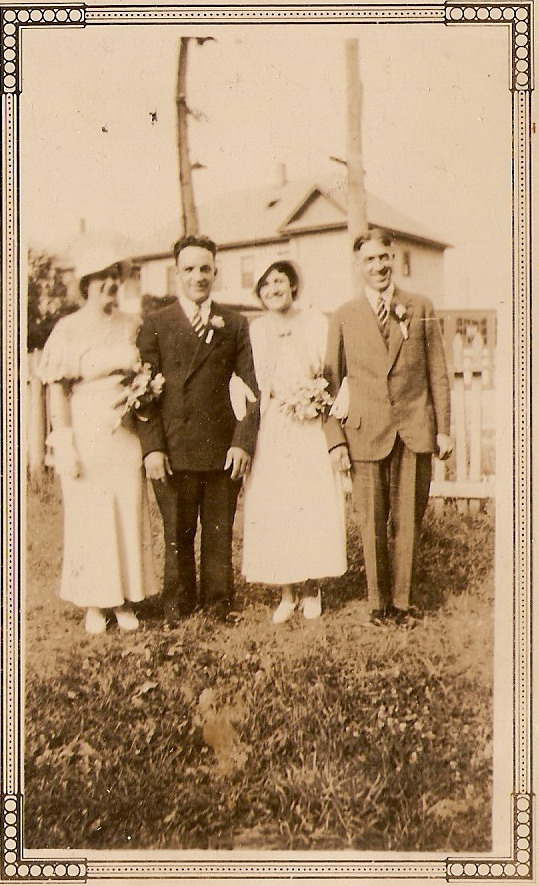
Archibald Romeo Spoor and Marie Rose Adrienne Brault were married June 29 1933. Reverend R W Decosse performed their wedding ceremony at the Saint Joseph’s Church in New Bedford Massachusetts. They are the couple in the middle.
Best man at right is Albert Oscar Marotte and maid-of-honor at left is Medore R Béatrice Cusson. Albert and Beatrice were also a married couple having gotten married a few years later. Beatrice Cusson is the youngest sister of Aurora Cusson who was Archibald Spoor’s first wife. She died in 1932 of pneumonia.
Aurora and Beatrice have parents of Édouard Cusson and Emma Johnson. Aurora was born 27 October 1901 in New Bedford and died 16 April 1932 also in New Bedford. She married Archie in 1923 and had three children with him – Lucille, Rita, and Jeannette.
Medore Béatrice Cusson was born 12 December 1906 in New Bedford and she died 22 January 1992 in Cherry Hill New Jersey. She married Albert Oscar Marotte who was born 5 May 1903 in New Bedford and died 25 March 1985 also in New Bedford. His parents are François M Marotte and Roseanna Benjamin.
Some other information about my grandparents might be useful. Archibald Spoor was born 21 May 1903 and died 11 December 1973 both in New Bedford. Adrienne Brault was born 16 May 1912 and died 20 October 1997 both also in New Bedford. They had four children together.
I am trying to determine when Medore Beatrice Cusson and Albert Marotte got married and what city. Who were their attendants at the wedding and what church and priest were used? Lastly, did they have any children and grandchildren together?
Comeau family is seen here. There are four rows with three in the top row, four in the second row down, five in the third row down, and four in the front row. Joseph Felix Comeau and Julie Legendre Comeau are the parents here and they are in the middle.
Topmost row: Joseph Treflé Comeau – Télesphore Ernest Comeau – Édouard Zépherin Joseph Comeau
Second row down: Honoré Comeau – Joseph Ferdinand Comeau – Joseph Frédéric Comeau – Louis Phillippe Comeau
Third row down: Désiré Comeau – Joseph Félix Comeau – Marie Julie Euphémie Legendre (Comeau) – Évangéline Comeau – Adéline Comeau
Frontmost row: François Xavier Comeau – Jean Alfred Comeau – Joseph Jacques Étienne Comeau – Marie Anne Comeau
Hopefully, we can keep improving on the identification of there people. This family photograph is perhaps from September of 1883. My grandfather Trefle Comeau, in back with the checkmark on his collar, was married that month. Notice Jean Alfred in front center has a black right eye. Can anyone help me further with this photograph?
Dorila Brault and Israel Fortier had 6 children that lived to adulthood. Their mother Dorila died in 1935 at the age of 33. The children went to live with relatives and friends from that point onward. Seen below is a group photograph of the extended family. The man at the right is Israel Fortier and by his side holding the infant is his wife Dorila Brault. The image is from about February 12 1922. The couple in the middle is the parents of Israel and this is their 50th wedding anniversary.
Back L-R: Lenore, Aldie, Merila Front standing L-R: Azelina, Archille, Josephine, Dorila (holding Josephine) Israel & Leoda Front sitting L-R: Johnny Giroux (Azelina’s son), Lenore’s daughter ? if it is Muriel and her son ?
Dorila Brault married Israel Fortier on 23 April 1919 in Clyde of Alberta Canada. They had seven children but one died young. She died at age 33 in Clyde Alberta. Do not know yet about the cause of her death. When she died the girls went to live with a sister of Fortier and the boys went to a religious orphanage. Three of her children are still alive as of summer of 2012. They are my mother’s cousins. Wish I had a full group picture of her family in Clyde.
1 – Martina Fortier (1920-1922) Died young in Clyde.
2 – Josephine Fortier (8 Feb 1922 to 19 Oct 2007) Married John Cumming in 1944. Had three children in Saskatchewan. Moved to British Columbia.
3 – Ovila Gerald Fortier (30 Apr 1924 to 07 May 1987) Married Esther Cormack. He moved to Quebec.
4 – Lucille Fortier (17 Jun 1926 to)
5 – Georges Fortier (25 Jul 1928 to 11 Feb 1999) Married Margaret Kelly and had five children.
6 – Yvonne Fortier (17 Dec 1930 to) Still alive and in Alberta.
7 – Achille Hubert Fortier (04 Mar 1933 to) Married Marie Jean Girard and has two daughters.
The Landreville family of Saint Paul, Joliette, Quebec is shown here in about 1907. My father’s uncle Albini Landreville is at back right and his parents are in front middle. They had 17 children of which some are seen here. Photo thanks to a couple of my second cousins from the Landreville clan. Albini would immigrate to New Bedford and marry my father’s aunt – Dorothy Comeau – in 1913.
Identification is as follows: Damase at left back hiding off the photo – Elida at top left near him at edge- Henri at back middle – Elmeria at right back – our Albini – Antoine at left center row – father and mother – Rose-de-Lima at left front – Marie-Ange at front right – Omar at right front
The parents are Joseph Camille Gauthier dit Landreville and Rose-de-Lima Richard. They were married in 1887 in Saint-Liguori, Montcalm, Quebec. Their eldest son was Albini but of the other 16 children we know only names and some birth dates and locations. Albini was born in Saint Paul, Joliette, Quebec, Canada on 1 May 1889. I have recently found the family on the 1911 census in Canada.
Does anyone know more about the children born to this family? How many of them came to the USA and what happened to the rest? In the picture, I do not really know which of the older girls is which. Of the two older girls one is a half sister of the rest of the siblings.
Sherlock Holmes solved cases through the use of deduction and the careful use of adduction. That is he collected all evidence in his mind and made logical conclusions and also he would then fill in the missing pieces with adduction or guessing in a reasonable manner. The life of Alphonse Brault is like a 1000-piece puzzle. There are 300 pieces down in order and 700 pieces are either missing or still awry. What the rest looks like, however, is already in place since a pattern has emerged.
Alphonse Brault is hurrying toward the train station with his daughter Dorila. He had her pack her bags the night before and they woke up early to catch the first train to Chicago. They were going on a new life for the third time together and this one he wanted to be stress-free. From Chicago he would catch the next day train for Edmonton. Five of his siblings were in the northern Alberta area and he would join up with them. They had written him sporadic letter telling him about the successes that they had on their homesteads since they settled there at the beginning of the decade. They would be surprised to see him and also would be secretly upset. He has been thinking of getting a homestead going for himself but never could push himself to do it.
This is early October of 1917 and this is New Bedford. Alphonse is in trouble again and is fleeing. He is an elusive character that knows how to exist at the edges of society. Until now. The Italian Mafia of New Bedford has always squeezed him for more “protection money’. Booming port cities always have a dirty side and an underbelly of characters that know how to exist in it. Sure there are the merchants, the bankers, and the mill owners. Sure there are the immigrant workers and the retail districts. There are also surely the criminals, the prostitutes, and the lunatics.
The Mafia had been building its threats since the summer began. He was getting late on payments to them. Business was good but he liked to gamble and he liked to buy his many girlfriends gifts. There was no waiting around this time. The final threat came the afternoon before. They had threatened the life of him and his daughter. Dorila had always been the one ray of goodness in his life and his heart. There was no way that he would ever let anything bad happen to her. He was a rotten father and a conniving person but there was always this daughter to give him some hope for a better life.
The trip was all to the west for the two days. The sun would not be in their eyes as they looked to a better future. He bought the two tickets from the $1000 he removed from the back that morning. He felt a relief as he stepped into the train. Alberta or bust would be his motto for two days.
Alphonse Brault was born in Quebec in 1873 to poor parents of Acadian extraction. His father Damase had lived in an orphanage until he was in his mid-teens even though his parents were still alive. The poverty of the family was too extreme to keep him. Damase had promised to himself that he would be a great father to his children and I am sure that he was. He married Olympe Gendreau in 1863 and they like nearly all Quebec family had many children – 17 in number. Some would become nuns, some homestead farmers in Alberta, and one a barber – postmaster. Usually there is some resemblance between the personality of the parents and each of the children. The Brault was like that with many with healthy domestic attitudes and strong work ethics. But remember the nursery rhyme
One flew east, One flew west, One flew over the cuckoo’s nest
Some of the Brault family settled east in the eastern townships of Quebec and towns of New England. Some of the Brault family settled west in Alberta. But Alphonse selected to go the way of lunacy. Psychopathy is characterized by restlessness, promiscuity, morbid lack of remorse, superficial charm, irresponsibility, and impulsivity. A person is born with it at a rate of about one-percent of the human population. One is born with it since it is a genetic problem just as a certain percentage of people will have any problem caused by DNA. Alphonse has all the characteristics of a psychopath but he was also brought up in a Quebec culture that placed a high premium on morals. Bad people are only bad some of the time in such a society and that was what he became – a sometimes bad person.
Alphonse went to school in Weedon in the eastern townships. Usually, this would be a trivial detail but he had two schoolmates – Edmond Fontaine and Eliza Hade. Both of these youngsters were from migrant farm families. They moved with the seasons from villages in the eastern townships of Quebec. Edmond was one year ahead of both Eliza and Alphonse but that did not matter much since school was flexible to the children of farmers. Students would go to class for three months and then leave for three months. Nothing was settled. Not school – not work – not home. Alphonse, Edmond, and Eliza became best friends with each other. They would only see each other for about half the year but they understood each other’s difficult life. Each would end their school career at a very young age as all Quebec farm children did but they still were migrant workers roaming between the same four towns – Scotstown, Weedon, Wolfeston, and West Bury. As their childhood blurred into the distance, each picked up a new trade along the way. Eliza loved to sew and care for her young brothers, Alphonse loved to construct houses and ride horses, and Edmond loved to hunt and fish. They would still stay in touch often and their friendships would change. Eliza as she turned into a teenager became the beauty of the county.
Eliza Hade had been left fatherless by one year old. Her father died before the birth of her brother occurred leaving her mother Elise with much to deal with. Before Eliza turned three she had a new stepfather and then two brothers and one sister came into the family in the next four years. She had been brought with strict morals but during her teen years she had many suitors. Edmond Fontaine was always a favorite of hers and when he started coming around more often she was overjoyed. In June 1893, when she was 17 and he 19, they wed in Scotstown at the Saint Paul Church. Edmond was a hard worker and he hit the fields early in the day each and every day. He had a new family and soon he would have a new daughter Louise. They would board at a different farmhouse each season but their life was better since they were happy together. Edmond still enjoyed his hunting and would go out whenever the opportunity arose.
One such day did occur on Tuesday, August 7, 1894. Alphonse Brault with his young brother Joseph Brault had asked Edmond to go hunting. On a bright, hot August day farming in the heat was out of the question so Edmond agreed. They each got their shotguns since each was an avid hunter. Edmond was living in Scotstown and the Brault brothers in a nearby village. They agreed to go down into a meadow section beyond the farmland of the town. They broke up as they near the brook that was at the eastern edge of the town. Edmond went into a grove of trees as much to get away from the blazing sun as to hide himself from the wildlife. Joseph was distracted and forked in the other direction since he thought he saw something in the brush. Alphonse stayed down the middle and stopped behind a large tree. He had slyly watched where Edmond had gone. He also slyly had watched his brother go off to the brush away from his vision. Alphonse knew his time was now and hid by crouching behind the large tree. He pointed his gun toward Edmond who was looking the other way.
Alphonse then called to his brother telling him that he had shot a large bird. They both hurried to the area. Joseph had gone quickly and was there first. He noticed that it was Edmond and he let out a scream. Joseph was only 13 years old and this was one of the first times he ever hunted. The sight of death was new to him. Alphonse tried to keep his brother calm but to no avail. They were only one hundred yards from the nearest road behind them and they notice a farmer leading his horse drawn cart. They called to him and he came near. They told him how Edmond had been accidently shot. He agreed to bring them and the body back to the village.
Forensics were non-existent in 1894. Footprint and fingerprint analysis was in its rudimentary stage. If a criminal was not caught red-handed nor with eyewitnesses around, then the best that could happen is that a lawyer would break the criminal in the courtroom. The police questioned Alphonse but he explained that it was an accident. The hunters had lost track of where each other were. Hunting is dangerous and there is at least one hunting accident each year in New England and the same rate in southern Quebec. The police could do nothing. Psychopaths are cold-hearted and cold-blooded. Killing a man was about as vile as stepping on a bee that had just stung you.
Alphonse had harbored a secret love for Eliza since his early teen years. She came and went so quickly that he could never get her to take a fancy to him. Always an envious and vindictive person, his love for Eliza became so deep that he contemplated killing Edmond. As other girls refused him, his envy deepened beyond control. During the summer of 1894, he saw his chance and knew the best way was via a mysterious hunting accident. His young brother was a great alibi. He knew his brother was naïve and new to hunting and that he focused quickly when events happened. By the next spring, his brother Joseph was dead from a horse riding accident. Alphonse was a great lover of horses and kept three on his small farm. One day he let Joseph borrow the wildest of the lot. Joseph was found the next day a half mile from the cabin. His head had been smashed in perhaps by the hoof of the horse. Joseph was dead and so was the only possible witness to Alphonse’s crime.
The police were the one’s that told Eliza about her husband’s death but Alphonse came by a day after the funeral with his brother. He told her how sorry he was and that it was a horrible accident. They all started crying about their dear friend. Eliza believed all that she was told and forgave Alphonse. She was a very forgiving person. Alphonse however had another goal in mine. He invited her to go to the grave with him so they could lie flowers on the plot. She accepted and they went the next day. Each day he would come over to help with household tasks such as chopping wood or running errands. To such a person there is no true remorse and his only goal was to wed her. She had fallen into his trap since she was sincere and thought all others were too.
Alphonse Brault and Eliza Hade married in September 1895. Her stepfather had died by then. Her closest companion was her brother Antoine. Antoine did not trust Alphonse. His emotions did not seem sincere to him and his dark staring eyes seemed inhuman. There was nothing he could do by the end but he watched his sister from afar throughout her life. There was already a child Louise and then there would be more – Antoine Brault was born in July 1896. He was named after his Uncle Antoine who would be his godfather. Life would settle down for the new family. Alphonse would be a home contractor in Compton County and Eliza would be a housewife instead of a migrant farmer. Adrien was born next in 1898. A girl Rose was born in 1900.
Everyone has a soft spot and that is their hobby in life. Alphonse’s soft spot was his horses. He wanted to raise his children to be horse riders as he was. When Dorila was born in 1901, she became the joy of his life. As she grew, Alphonse got her into horses. She was a tomboy type and loved being outdoors with the horses either feeding them or riding them. By the time she was seven she was already taking lessons from her father.
More children would come and go though. Marie Antoinette in 1903 would die within months of birth. Her brother Antoine would die the same year. Joséphine would be born prematurely in 1904. Marie Louise Germaine in 1906 would die months later. Germaine born in 1907 would live until 2002. Then sickly Sylvia would be born in 1909.
This large family needed to be feed and thus Alphonse moved more into house building in the Brompton and Sherbrooke areas. Sherbrooke and its suburbs had a blooming industrial base and the population increased greatly. He was a good worker by day but by night a shifty person. He loved drinking with his peers, gambling on horses, and the company of woman. He gave excuse after excuse to his wife where he was going. She understood her husband needed to be away with customers to draw up plans about houses. She understood that her husband needed a hobby outside the home and thus the horse racing was accepted.
Alphonse had come to the vision of his next goal. Make money off the gambling, drinking, and prostituting of Sherbrooke by opening a tavern at the northern outskirts of the city. As visitors came from the northern cities to Sherbrooke, they would see the tavern and come back there at night. A tavern in the beginning of the 20th century was a multipurpose building that was a waypoint for travellers. It would serve food and offer rooms in the front, but sometimes offer drinks and gambling in the back. His wife agreed that the tavern would be a great moneymaker. Supplement the home construction business with a weekend business of a tavern. Alphonse built the tavern in 1903 within a few months. Soon it was one of the most popular places outside the big city of Sherbrooke. All businesses there were actually legal but frowned upon by the temperance movement of pre-prohibition Canada.
The temperance movement was the precursor to the Prohibition Era in both Canada and in the USA. Women would hold protest meetings right outside taverns and bars. Holding signs to disgrace tavern owners and smashing glass inside bars. The laws were not behind them, but still the movement was effective in that the neighborhood did not want the bars there in the first place. This did not bother Alphonse – nothing much flustered him. But an event did happen in the summer of 1909. Something caused him to get very upset or bothered. Not his family but something happened at either the tavern or in his social life that caused him to flee. No one has stepped forward to report what it was and no document or article exists to guide me. But in August of 1909 he fled Quebec with his favorite daughter Dorila for Massachusetts in the USA. They gave aliases as they passed through Newport Vermont’s entry point. But by the end of August 1909 they were in New Bedford. What could he have told his wife? What goals did he have in mind in the new country? Maybe the police were after him or maybe his gambling debts were large. Leaving his wife, eight months pregnant was tough so he must have left a lot of money.
Eliza Hade was a patient and kind person. What ever she was told she accepted since she loved her husband. Anyone of her brother-in-laws could have helped her. The farm and tavern needed to be sold. Her half-sister Eveline Dion was a great help in taking care of Eliza children. Alphonse told Eliza some convenient lie and told her that he needed to leave for Massachusetts the next morning. He told her that he would write back to her when he was settled there. He also told her that he wanted to bring Dorila with him. These all surprised Eliza but there was no way she could protest. She knew very little about what was going on but she trusted him.
Alphonse and Dorila arrived in New Bedford in late August of 1909. They settled into a rooming house for a while. She needed to attend school so he signed her up for 3rd grade at the public school. He needed a job quick and so he obtained one at a local pool hall. That was a profession he knew well and it was good for him to learn English quickly since there was a lot of socializing. His brother Edmond would join him in January of 1910. They would get a three-bedroom apartment at 41 Beetle Street later that month and also get a business front on the ground floor of the same building. Alphonse would open up his own billiard establishment and Edmond would have a barber’s chair in the same space. A daughter was born to Al and Eliza in September of 1909 right before he left. He wrote to Eliza to remain in Sherbrooke for at least a year since the child Sylvia was a bit sickly. He was quite busy in his new home city and enjoyed the freedom to establish himself. He had thoughts about other businesses that would bring in more money. Every Sunday he would bring Dorila to the New Bedford Trotting Track to watch the horses. He would bet on them and she would just enjoy the sights.
Edmond was not happy being in New Bedford. His barbering business was not good since there was so much competition. Three of his brothers had headed for Alberta that summer of 1910 and he wanted to join them. Besides living with Alphonse was tough for him since Al was so restless at night. Like being with a tiger – Edmond thought. He told Alphonse about his plan to go to Edmonton. Alphonse did not care – his work was improving to the point that he could expand his business ventures. Thus Edmond left in the late fall of 1910 and Alphonse moved his residence but kept his business going at the same place.
Prostitution was legal in Massachusetts since the colonial days. Hard to imagine now but it was not until 1918 that it became illegal. Alphonse knew that letting a room out to a prostitute and her customer for a while could build up money fast. So the apartment he just moved out of he kept for business – the prostitute business. That was a booming trade in the growing port of New Bedford and the area he was in was good for it. Sailors visited the saloons and restaurants around the area frequently. So in November of 1910, Alphonse had two businesses going. His wife Eliza back in Sherbrooke was writing him every week and now she was pressuring him to let her go there. He had dutifully been sending back money to her and writing about how his work was going well. Problem was that two of the daughters were born sickly – Josephine now 6 was still very small since she had been born premature and Sylvia now 1 could not walk well due to arthritis. He told them to wait until the spring when school was done for all the children and then come.
The plan worked. He told a few prostitutes in the area that he had a temporary room for rent by the hour. Word got around and his future plans were for even more. By early in 1911, he had enough money saved up to rent out a building on 25 South Second Street in New Bedford. He used the front of the ground floor as a restaurant and the ten boarding rooms inside he used as habitation for his family when they came in June and for temporary rentals to customers. He moved his pool hall across the street to 10 South Second Street. His wife arrived in June along with four of his daughters. It was easy to run the businesses since they were all nearby. He had hired three managers for the two businesses – with he running the restaurant at night. It was also easy to keep the goings on from his wife since their rooms had windows only to the back and she was quite busy with housework and their daughters. This plan was only temporary he knew since the family needed a better place to live.
Eliza on her part decided to take some sewing work in to supplement the income. She had been a seamstress part time in Quebec and she was good at it. She was a hard working person and loving all the work she had – housework and sewing. She did worry that Alphonse would come home late into the night but he told her that both businesses took a lot of his time. She worried but believed him but she had a new concern – she was pregnant again. Adrienne Brault was born April 16 of 1912. The growing family needed more space and besides Alphonse wanted to keep the seedy side of his businesses fully away from his wife. By October, he was looking in Fairhaven, the town to the east of New Bedford, for a house. He had found a comfortable looking one at 58 Hawthorne Street. He decided to rent one of the floors there and had moved his family by November. The dual plan worked well since the 8-member family fit well into the new rooms and he was able to concentrate on his work more. He had told his wife while in New Bedford to never bother his restaurant work and she complied. Alphonse also had an excuse now to stay out later.
Gambling was legal in Massachusetts until 1916. The temperance movement across the USA had no only alcohol use on its agenda but also the gambling and prostitution. This trio was acknowledged to damage the lives of many. Alphonse was into all three by now since he had turned his pool hall into also a gambling den. Prostitutes would frequent both places. His monthly income grew and he needed it since in 1913 there would be three more members to the Brault family. Ovila Brault was born to Alphonse and Eliza on the 15th of June 1913. With so many young children in Fairhaven, Eliza wrote to her half-sister Eveline Dion in Sherbrooke Quebec. They had formulated a plan years before that Eveline, who was caring for Eliza’s daughter Josephine in Quebec, would join them in the USA. Now was a great time since school was out and Josephine was growing larger leaving her sickly nature behind. The family now had 11 members with 3 of them being pre-school age. Eliza and Eveline loved each other and thus the household was quite harmonious. They both worked hard at housework and at sewing.
Eliza’s oldest daughter Louise was a great help in the past years but now she had a boyfriend and would soon marry. Louise Fontaine was always suspicious of stepfather Alphonse Brault. She could see his behaviour better now that she was in her late teens. She never wanted to discuss him with her mother and with Dorila since there was so much love there, but with her 13 year old sister Rose and her aunt Eveline, she had quite discussions. Louise had left school at age 15 and had been working for four years outside the home at a factory job. Sometimes she walked by the restaurant and noticed the seedy characters that went in there and often wondered to herself. Eveline also worried for the family since Alphonse came home a couple of times a week quite drunk. Louise Fontaine married Alfred Morin on the 10th of February 1914 in Fairhaven. The ceremony after the church wedding was held in a small hall. Louise knew that she would no longer be able to look after her young sisters since she would live elsewhere in Fairhaven. During the ceremony, she took Eveline aside and told her to watch over her sisters well – all of them. Eveline knew what she meant.
Within a few weeks, Eliza Hade would be pregnant for the 13th time in her life. This number is not unusual for an immigrant family in that era. That only 7 of her children would live past 10 years old was also not unusual. On November 8 of 1914, Antonio Brault was born to this large Fairhaven family. He was a healthy baby and his chances of living were high since he was away from the squalid French ghetto of New Bedford. Eveline and Eliza kept working hard as usual but Alphonse was near his breaking point. His life at the restaurant was carefree and he was able to socialize with customers and waitresses. At home, it was crying young children and nagging women. He would always stay late at work to avoid this but it was getting harder to do so.
On a Thursday night in late February of 1915, he came home drunk as usual. His infant son Antonio was crying and he screamed at his wife to keep it quiet. In the chaos, Alphonse picked up the baby and shook it violently for twenty seconds. He placed it back in its crib and went to his room. Both Eliza and Eveline, who also had wakened and rushed to the room, went to the baby in great concern. They tried to caress the infant but got no response. Antonio’s skin grew paler and moist. Eliza was horrified and screamed at Alphonse through the bedroom door “You killed the baby!”. He came out of his room and walked to the child. He glanced at it and then went back to his room again and locked it. Eveline and Eliza were both sobbing. They did not know what to do. It was now 3 in the morning. Both whispered to each other for the next couple of hours through their sobs. Alphonse needed to go to protect the other children. They did not however want to report this to the police.
By dawn, Alphonse was milling about his bedroom. Eliza knocked lightly on the door. Alphonse grumbled a bit before coming out. Eliza with Eveline by his side told Alphonse that she did not want him there anymore – that he needed to leave immediately. She had packed his clothes and packed him some food. She also told him that he needed to bring the dead child to the medical examiner in New Bedford. Shaken baby syndrome was not well known of 100 years ago. The symptoms were obscure. Death was prevalent among children in this city. There were 20 deaths a day for the examiner to look into with 10 of those being of children. Alphonse walked the mile to the medical examiner’s office. Daniel O’Brien associate examiner was on duty at this early hour. Eliza had wrapped the child in a blanket and now Alphonse handed the dead child to the doctor and he went into his office. No symptoms were apparent to his eye. No rashes, no cuts, no bruises, no wounds, nothing. This was a city where death haunted the children and this doctor had seen tens of thousands of child deaths. This one seemed peculiar but he had no technology to aid him. After ten minutes in his office, he came out and handed Alphonse a death certificate.
Alphonse had gotten out of that ordeal as he had gotten out of so much before. He hurried to his restaurant in the cold February morning. He knew that he could stay a few weeks there in one of the spare rooms. It would not be pleasant since the street was a busy one and hence lots of noise. Most of the customers he liked but some talked poorly about him and some he thought poorly of. Most of all he knew that he was going to miss Dorila the most. She was always his favorite daughter and always would be. They rode horses down at the stables a lot on Sundays and he would miss her then the most. He would not miss his other children nor his wife. So much crying and illness at that home. And there would come more problems from that direction. In January, a regular customer at the restaurant and a regular user of the rooms for prostitutes had called Alphonse aside one day. This man knew that his daughter Rose was now 14 years old and had yet to have a boyfriend. He knew Alphonse well enough to talk about anything with him. He offered Alphonse $30 and $30 more to Rose, if she would provide services to him for an hour in a backroom. Alphonse agreed at once to this proposal. To was an incredible sum of money – more that a mill workers monthly wage.
Later that month Alphonse told Rose that he would need extra help one evening. She had been working for the restaurant one day a week any way since the previous summer. Hence, she quickly obliged. He had arranged a time with the customer too and when he came he told him to quickly go to an upper room. Five minutes later Alphonse motioned to Rose when the restaurant was not too busy. He told her to go to the upper room of the building to fetch some spare plates. An hour later the man had left out a back door. Alphonse went quickly to the room. Rose was sobbing quietly. Alphonse told her to hush and handed her $30. He told her to go home and tell no one about it ever.
Dorila was in 8th grade and her last year of school. She was a good student but knew that mill work and being a mother was her future. Eliza had told her children that June would be their last month in Fairhaven and hence their last at the Fairhaven schools. They needed to move to New Bedford that summer to get a lower rent. She had saved money and was able to pay the rent but it would run out soon now that Alphonse was out of the home for good. Eliza did not trust Alphonse at all and to that end she had sent her two youngest remaining children – Adrienne and Ovila – to an orphanage in Fall River. Orphanages were run by the Catholic nuns and accepted all children wether they were true orphans or not. She wanted it to be in Fall River 5 miles to the west since Alphonse would never be able to find the children there in order to take them away or to hurt them. That would leave only a 7-member household for the next few years, five daughters – Rose, Dorila, Germaine, Josephine, and Sylvia – and then Eliza and Eveline. Only the last three daughters would be in school in September of 1915. Rose would find steady work at a maid in a home and Dorila would find work as a loom worker in a cotton mill.
Eliza had told her daughters to stay away from Alphonse and his restaurant. For Rose that was easy and her work was in Fairhaven anyway. Dorila was still in school in the spring of 1915. In mid-April, Rose had asked Dorila about menstruation and pregnancy. Dorila wondered why but answered as best she could. They were the only two teenager girls in the neighborhood but had asked their mother a few questions in the past. A week later after the first discussion, Rose confided in Dorila that was not having periods any more and that she thought she was pregnant. Dorila was aghast and asked how that had happened since she knew that her sister had never had a boyfriend. When questioned, Rose lied and stated that a boy two streets away from their home in Fairhaven had gotten her pregnant. The conversation stopped there but Dorila brooded over a solution for a few days. Their mother would be furious since there was already money problems in the home and many children. Dorila thought that perhaps if she told her father, then he would be able to come up with a good solution. Maybe he could give Rose a little bit of money each week or could pay for an apartment for her.
Dorila went to see her father the next week after school. She had to hurry since her mother did not want her out so long after to school. She went briskly to her father in the restaurant and whispered to him away from any of the tables. Alphonse turned pale. He was a quick thinker and came up with a plan immediately. He told Dorila to go home and tell Rose to come by after work tomorrow. Yes he would get her a room to live in. Away she went thinking that she had done the right thing and that her sister would be happy with the plans that would be in store for her.
Rose was happy to hear what Dorila had done for her. The next day she left work an hour early in order to go see her father. She did not like the restaurant but she knew that this was a great plane. Alphonse told her to follow him. He by nature of his job knew many of the underworld people of New Bedford. From grave robbers to card sharks, he knew all the shady characters. He had arranged the night before to meet with a local doctor. This doctor did illegal abortions for a hefty fee. Alphonse took Rose in the back way in order not to have her see the office in front. He told her that she would see a room to let back here. Once there the doctor quickly sedated her and performed the abortion. With proper lights in this room and without a nurse and being in a great state of anxiety and rush, the doctor did the work as needed but botched it. Rosa started bleeding so he applied a towel to the area. Out they came from the office and Alphonse quickly grabbed Rose and went down the alley. He could see that she was still groggy and bending at the waist a bit so he thought that it would be best if she slept for a bit at the restaurant. He brought her through a back door and rushed her into an upper room. He could see that she was hurting and so he brought her some ice and a new towel.
Alphonse did not expect it to be this bad so he had her sleep the night back there. He worked and later spent the night in a room near her. He would wake during the night to hear her moaning and to think about a story to have her tell her mother. About noon the next day, he had one of his waitresses help his daughter Rose to Fairhaven. The plan was to tell Eliza that Rose’s family she was a maid for had her stay late for a party at the home. Eliza would have none of it since she could see how pale and weak Rose was. Dorila stayed in her room since she was scared to get involved. Gradually, Rose opened up about the situation and told the story little by little to her mother. Eliza was horrified. She could not let Alphonse get away with this behaviour. She calmed Rose down enough to have her get to sleep. Then Eliza left for New Bedford. She had never been this outraged in her life. When she got there she stormed in and charged up to Alphonse. “What have you done to my daughter?” she yelled. She told him that she would tell the police this time. She would not stand for his evil doings any more. She left. As she walked back home, she felt relieved that finally she had done what was needed for a long time. Alphonse was visibly shaken by the ordeal. He truly believed her when she claimed that she would call the police.
Alphonse was for one of the few times ever unnerved. He rushed to his room and packed quickly. He always was good at devising plans. This time it was drastic. He told his manager that he was closing up shop on both sides of the street. The owner of the building lived only two blocks away and Alphonse stopped there and told him the business was not going well and that all was closing. He had many connections in the horse racing trade and so he went to the New Bedford Trotting Park to sleep that night. It was away from the police and his family. Eliza ended up not telling the police but Alphonse did not know that for sure. He stayed at the trotting park for the summer and fall working as a helper and sleeping there for the night security shift. Since his wife did not seem to follow up on her threat, he started to device his next plan. Eliza did end up moving the family back to New Bedford to 61 Bullard Street. She also needed for the first time in her life to go to a job outside the home. She still had her sister with her and she took care of the children in the afternoon when they came home.
Alphonse was on the prowl again through the streets of New Bedford. At night he would wander the streets looking for the best location to set up shop again to make some more money. His last restaurant was near the New Bedford Police Station near Spring Street. This one he wanted in that area since it was close to the ports and thus the prostitutes. The police station was undergoing major renovations that year. So much so that the area had a lot of traffic. He decided to place his new restaurant near the old but two streets more away from the ports on School Street behind a movie theatre. He set up shop once more in December of 1915 and as always his business grew rapidly. The place was small so it was more like a tavern than a restaurant. This time he had no reason to obtain an apartment so he simply lived in a room above and to the back of the tavern. He kept things simple this time. He only hired a couple of waitresses and tried to hold the prostitutes down to a lower level.
He did still go down to the trotting park every Sunday afternoon to race the horses and throw bets down on races he was not in. Business was good enough at night that some times he could go to weekday races. He dreamed of some day owning horses again. The passion of riding them was strong. He still got to see Dorila about once a month too. She would come over to the tavern whenever she got out early from the mills. She would turn 15 in a few months. They would converse about horses and their former life back on the farms in Quebec. They would both agree that someday they would make their life better. Dorila would also discuss her home life but that would not interest Alphonse. He was into his business, horses, and girlfriends. Only problem now in his life was the pesky mafia was gaining more power as the temperance movement headed toward the prohibition movement.
Alphonse could never keep the mob happy. He was a disagreeable guy and they were greedy. When Dorila turned 16 in the spring of 1917, he talked to her about moving to Alberta with him. They could get a stake on a homestead land. He had been saving money and also corresponding with his brothers Rodrique, Arthur, Edmond, and Eugene and especially with his sister Emma all in Alberta. That summer was rough in the cities of New Bedford. Gambling had been outlawed in the fall of 1916 and the mafia tried harder and harder to get more money from taverns and bar owners. By the September of 1917, Alphonse had had enough.
Clyde was a growing homestead town in 1917. The land was tough to farm and the winters were harsh. Slightly more than half of all homesteaders failed. It took a great deal of hard work to harvest a crop in the short season and to keep the domestic animals corralled. Alphonse got help from his brothers in the beginning. Seed was expensive and it took many to build a house and barn. He knew how to focus on tasks and he had plenty of experience in the house-building trade. Little by little, he developed the plot into a viable farm and each spring he would put as much money back into the development of it as possible. By the spring of 1921, he was able to file for permanent ownership of the homestead land. On the application, he dutifully placed the amount of crop he harvested each year and the number of each animal species he had. The work must have been hard but he was good at it.
His daughter Dorila lived with her aunt in a home across the lake from him. She was wedded to Israel Fortier after being in Clyde only 17 months. She too would take out a homestead with her husband. They would succeed at the farm but she would need to also work at the Clyde Railroad Station running the restaurant. She would give birth to 7 children. Her life had changed just as much as her father’s had. Alphonse would visit her often and was proud of her and her growing family. He himself was succeeding enough by the mid-1920s to buy a couple of horses.
He always did love his horses and having Dorila ride them with him reminded him of the old days. In fact, his break from his tormented past was complete. His behavior was vastly better then in the past. This was the Prohibition Era in Canada as it was in the USA. It is not know if he was involved in illegal sales of alcohol. All that is known is that he was vastly more responsible to himself and his family. It is a bit sad to learn that he would have such a traumatic ending to his life.
On a cold January morning in 1933, Alphonse was emptying some waste from his home into the lake by his home. There were a few concrete steps from his land down to the lake. It was icy on the steps but he had descended them before many times. This time he slipped the slammed his head in the corner edge of one of the steps. He lie there unconscious for a couple of hours before a neighbor spotted him. He was rushed by ambulance to nearby Westlock Hospital. This was a new facility and had modern equipment.
During the weeks that ensued, it was obvious that his head trauma had hurt his ability to walk a straight line and had caused some disorientation. Within a few months he was able to be admitted to a rehab and by the early summer was released to his home. He was developing his ability to walk and to focus again and there was hope in the family. On August 11 of that year, however, there was a major setback. He had seizures at his home and was again rushed to Westlock Hospital. Two days later he died.
His funeral mass was well attended since he had many brothers in the area. Four priests helped with the mass including the old Clyde priest that he had known for many years. He was later that week buried at the Clyde Cemetery. His dear daughter Dorila would be buried there 2 short years later. It is not known if either of them have a gravestone. Alphonse had lived 58 years – the first 20 and the last 16 were relatively tranquil. The middle 22 years, however, caused dismay to his family and still cause concern amidst his offspring to this day.
Does anyone know about the origins of these families in Ireland?
Hugh Donoghue was born February of 1847 in Gortdromagh, Kerry, Ireland. He immigrated 22 Apr 1873 via Castle Garden and settled in Holyoke Massachusetts. He would marry Katherine E Looney of Holyoke in 1877 and have ten children with her there. Hugh had parents of Michael Donoghue and Mary Ellen Kerrisk and Katherine E Looney had parents of John Looney and Johannah Donoghue. John Looney was born in 1830 in Glenflesk, Kerry, Ireland and died 20 April 1883 in Holyoke. Johannah Donoghue was born in 1830 in Ireland and died 4 May 1889 in Holyoke.
Henry Walker Graham was born 19 April 1862 in Northern Ireland. His death was 4 November 1915 in Holyoke, Hampden, Massachusetts. His parents were Walker Graham and Elizabeth Bate of Northern Ireland perhaps Belfast. He would marry Ellen Bratton in 1887 in Holyoke. Her parents were Samuel Bratton born in Belfast, Antrim, Northern Ireland in about 1830 and Ellen Sloan.
John Somers was born February 1863 in Ireland and his death was 4 November 1924 in Holyoke, Hampden, Massachusetts. He married Mary E Baker who was born August 1866 in Ireland and who died 10 July 1915 in Holyoke, Hampden, Massachusetts. John had parents of Thomas Somers and Mary McHugh both of Ireland. Mary in turn had parents of Patrick Baker and Ellen Kennedy both of Ireland
Thomas McLoughlin of Binghamstown, Mayo, Ireland immigrated with his wife Bridget Corduff of Belmullet, Mayo, Ireland in 1905 to Holyoke Massachusetts. They had five daughters with them. Within a month Bridget and one daughter would die of measles. Thomas would remarry and by 1920 move back to Belmullet Ireland with this new family of his. His parents are George McLoughlin and Julia McCormick. Bridget had parents of John Corduff (1841 birth in Ireland) and Ellen McManamon (1840 birth in Ireland) who had an 1866 marriage in County Mayo.
Peter Cox was born in 1826 in Ireland to Peter and Theresa Cox. He would marry Catherine Reynolds who was born in Ireland in 1822 to John and Mary Reynolds. They most likely married in 1852 in northeastern Rhode Island. They would have a daughter Theresa in 1856 and a son Peter in 1858. Peter Cox was of low mental ability and would live in group homes throughout the late 1800s. The youngest Peter would marry Mary Ellen West in Holyoke in the 1890s. Mary West had a mother Mary Moore who was born March 1837 in Ireland and a grandmother Mary O’Brien also of Ireland.
Richard Keane was born in 1841 in Belmullet, Mayo, Ireland to Harry Keane and Margaret Connelly. He would marry Bridget Burke in about 1856. She was born in 1841 in Belmullet, Mayo, Ireland and die young in 1880. Richard would move to Holyoke to be with his offspring and would die there. Mary Ellen Rowland had parents of Patrick Rowland and Catherine McGrath and was born 12 March 1865 in Bangor Erris, Mayo, Ireland. She would immigrate to Philadelphia and then to Holyoke Massachusetts. In Philadelphia, she married Martin Keane who parents are the above-mentioned Richard and Bridget. They would moved to Holyoke and by 1908 Martin was dead but was not buried in the family plot.
John Reynolds was born in 1857 in King County Ireland. In 1878 in Tullamore, Kings, Ireland, he married Catherine Carey. They would remain behind in Ireland while many of their children immigrated to America. Their son John would marry Johannah Elizabeth Donoghue of Gortlicka, Kerry, Ireland in a 1916 ceremony in Holyoke. Her father was Cornelius Donoghue born in 1843 in Gortlicka, Kerry, Ireland and her mother was Johanna Cronin born in 1859 in Gortlicka, Kerry, Ireland.
Thomas Kennedy died in Ireland in 1905 in Glenlough, Ireland and his wife Margaret Habbert would die in Mahanabo, Kerry, Ireland.
Richard Foley was born March 1851 in Ireland to Edward Foley and Mary Fitzgerald. He would marry in 1871 to another Irish immigrant Bridget Powers She was born 1848 in Waterford, Waterford, Ireland.
Thomas Keaton Bourke was born in March 1848 in Ireland to Jeremiah and Nancy Keaton.
Timothy J Murphy was born in 1907 in Ireland and immigrated in 1928. He would marry Helen Viola Weed.
These are New Brunswick ancestors that I know very little about. If you know more, then please write to me.
Nathalie Hope was born 7 February 1834 in New Brunswick Canada and died in Bangor NY in 1911. She married Oliver Beaudoin in New York and had several children. He was born in 1832 in Quebec and died in 1909 in Bangor, Franklin, New York. They would have a few sons – one was William Boardway. The last name had changed from Beaudoin to Boardway in the USA. William Wood was born about 1825 in New Brunswick, Canada and perhaps she died in New York in the period from 1880 to 1900. Sophronie Green was born about 1827 in New Brunswick and maybe died in the 1910s in Holyoke Massachusetts. Their daughter Mary Wood would marry William Boardway in Hermon New York.
Alexander McLennan and Mary Finlayson were born in New Brunswick. He was born in May 1816 to Duncan and Katherine. She was born in 1826 to Alexander Finlayson and Christina McCray. Alexander would die in the range of years from 1900 to 1910 in Clinton County of New York. Mary Finlayson would die there from 1890 to 1900. They would have many children – one of whom was Janet McLennan. Jennie as she was called was born in Canada and died in South Hadley Massachusetts having been married to Lester Jackson.
David Thibodeau was born in 1816 in New Brunswick, Canada but moved to Maine. He married Celeste Landry in NB and had a daughter Modeste Thibodeau. She was born in 1841 in New Brunswick and died in 1890 in Maine. She married James Cochran of Maine in about 1868. James was the son of John Cochran (born in 1817 in New Brunswick, Canada and death in Maine after 1860) and Sarah Brown (born in 1826 in Miramichi, Northumberland, New Brunswick, Canada).
Permelia Walton was born in 1830 in New Brunswick, Canada and died in 1907 in Fort Fairfield, Aroostook, Maine. She was the daughter of David Isaac Walton and Elizabeth Post. Permelia married John W Thompson of Maine.
John W Duncan was born in 1847 in Scotland and died in 1902 in New Brunswick. Sabrah Jane Hawkes was born in 1859 in Hopewell, Albert, New Brunswick, Canada. They were married in about 1882. Sabrah had a father of William Hawkes who was born in 1833 in Hopewell and mother of Sarah Fenton who was born in 1836 in Hopewell also.
William Wilcox was born in 1820 in New Brunswick to Benjamin Wilcox and Luceanna Lake. Benjamin was born there in 1795 and Luceanna was born there in 1800. They would immigrate to northern Maine with their children.
The Loiselle family in 1915 in Holyoke Massachusetts. We are not sure about the two middle women in the back row. One is Marie Louise and the other Calendia. The other people are identified with a high degree of certainty but if anyone has any comment to add, then please write to me.
1ST Row: L to R – Louis Loiselle (photo over a stand-in) – Flora – Romeo 2nd Row: Henri – Telesphore – parents – Louis and Cléphire Loiselle – Wilfrid 3rd Row: Evelina – Rodolphe – Louise (?) – Elzear – Lina (?) – Alexina
The children of Ulysse and Gertrude Comeau have grandparents of Comeau – Henley – Dubois – Caron. The Comeau quarter and the Henley quarter were written of previously so this will be about the Dubois and the Caron quarter. They are by ethnic groups 95 % Quebec, 3 % Acadian of Nova Scotia, and 2 % Irish.
Joseph Dubois moved to New Bedford in 1892. Within 5 years his wife Clarise Peluge Roberge had died of anemia. He had five children to care for including George Emile Dubois. He would soon remarry and worked for decades as a weaver in the cotton mills of New Bedford. Joseph lived to 93 years old and is buried in the Old Sacred Cemetery far away from his birth place of Sainte-Sophie-d`Halifax of Megantic County Quebec. These Dubois and Roberge families had a long history of farming in the counties at the western edge of the Gaspe Peninsula – counties like Kamouraska, Levis, and Bellechasse. This stability is a good sign since they were not migrant farm workers but rather farm owners. The burgeoning population by the 1890s had forced many of the families to move south to the mill cities of southern New England. The son George Dubois would have 11 children with Marie Louise Eva Caron in New Bedford.
Napoléon-Noël Caron would move as a young boy to Nashua, New Hampshire without his parents in 1885. Nashua and Manchester were both giant mill cities and Napoleon would work as a mill machine operator. He would marry Marie Alvine Plourde in Nashua in 1890 and they would have 11 children too. The last of their children Irene Gertrude Caron was born in 1914 in New Bedford and is still alive having celebrated her 100th year two weeks ago. Both the Caron and the Plourde lines come from the small city of Kamouraska in Quebec. This is right above southwestern Maine and is surrounded by many farming villages. The genealogy is not particularly hard to trace but they do have long names in these tiny villages. Double first names and double last names were used into the late 1800s. For example, Alvine (Ovaline) Plourde had a maternal grandmother of Marie Emilienne Laplante dit Madore. Mostly, she was known as Emilie Laplante but on a couple of early census forms she was identified as Marie Madore. Thus some people are hard to track and consequently some death records are hard to find.
The Caron family is seen below.
Marie Louise Eva Caron was one of the many children of Napoleon and Ovaline Caron. She would marry George Dubois in 1912 in New Bedford at the Sacred Heart Church. One of their daughters would marry Ulysse Comeau in 1945 in New Bedford. They would have eight children themselves.